
1. Program Definition and Services
Meal & Nutrition Services in Wyoming provide short-term and ongoing dietary support to older adults, individuals with intellectual/developmental disabilities, and individuals with chronic health conditions. The program aims to help maintain individuals with disabilities in the community, averting the need for long-term services and supports. Services include:
- In-Home Personal Care: Individual nutritional support in the participant's residence (Home-Delivered Meals, Medically Tailored Meals, Mail-Delivered Meals, Grocery/Meal Kit Delivery, Special Dietary Accommodations, and Individualized Nutritional Counseling)
- Residential Personal Care: Supervision and care in an approved community-based setting (Congregate Meals at senior or adult day centers, Menu Planning & Oversight, Nutrition Education, and Dietary Progress Monitoring)
2. Regulations
The program is governed by the following regulations:
- Wyoming Administrative Rules, Chapter 45 (Standards for Home and Community-Based Waiver Services)
- Wyoming Department of Agriculture, Title 48, Chapter 1 (Wyoming Food Safety Rule Standards)
- Federal Older Americans Act (OAA) Title III-C Nutrition Service Guidelines
- Section 1915(c) Home and Community-Based Services (HCBS) Medicaid Authorities (Community Choices Waiver, Comprehensive Waiver, and Supports Waiver)
3. Licensing or Certification
Providers must be approved by the Wyoming Department of Health (WDH), specifically the Division of Healthcare Financing or the Aging Division, and hold a valid Food Service Establishment license issued by the Wyoming Department of Agriculture or local health jurisdiction.
4. Responsible State Agency
The Wyoming Department of Health (WDH) and the Wyoming Department of Agriculture are responsible for reviewing applications, verifying kitchen safety inspections, and certifying meal and nutrition services providers.
5. Application Process
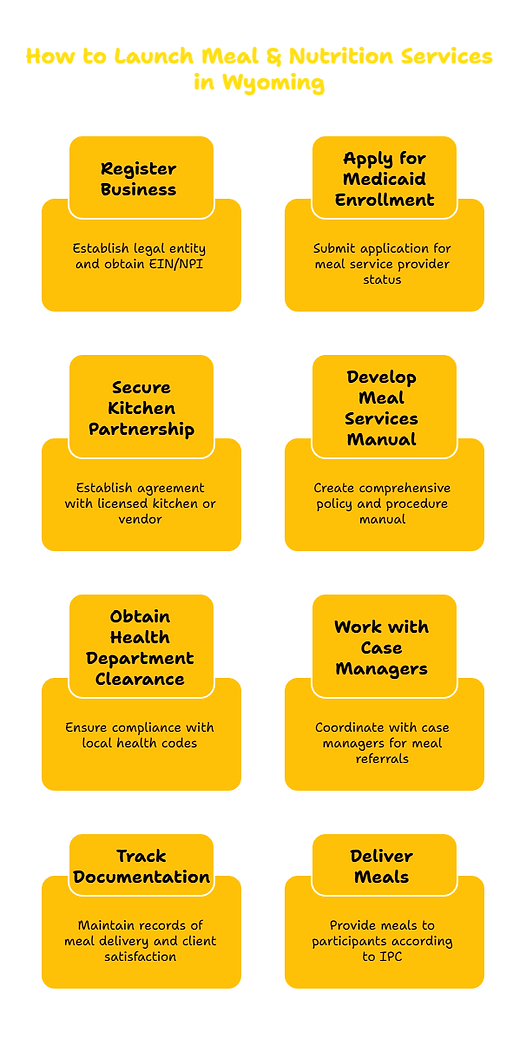
The application process is conducted through the electronic Wyoming Medicaid Provider Enrollment Portal. Providers must submit formal applications and credentialing documentation online to initiate the approval process.
6. Required Documentation
While specific documentation requirements vary based on the target waiver, providers typically need to submit:
- Proof of a clear food facility safety inspection conducted by an outside entity within the last 24 months
- Valid commercial food establishment license and facility sanitation permits
- Comprehensive Agency Policies and Procedures Manual (including food handling, cold chain delivery, and specialized diet workflows)
- Staff qualifications, ServSafe manager certifications, and active Registered Dietitian (RD) licensure (if offering counseling)
- Proof of general, auto, and professional liability insurance
7. Timeline for Approval
The exact timeline for approval fluctuates based on agency capacity. Providers should contact the Division of Healthcare Financing for current processing windows, which generally include food safety clearances before final Medicaid billing numbers are activated.
8. Pre-Application Process
Prospective providers must complete specific foundation tasks before applying. They must establish their business entity with the Wyoming Secretary of State, secure necessary commercial kitchen spaces or vendor partnerships, and obtain an Employer Identification Number (EIN) and a Type 2 National Provider Identifier (NPI).
9. Pre-Application Training
The state requires administrative and nutritional leads to maintain compliance with specialized training. Program access and automated enrollment systems are unlocked once agency policies, menu oversight systems, and basic credentials are verified.
10. Additional Notes
- Providers must ensure all menus are planned or formally approved by a licensed Registered Dietitian (RD) to meet standardized nutritional targets and special dietary modifications (renal, diabetic, low-sodium)
- Home-delivered meal services must be provided directly by the certified agency's personnel or through legally binding subcontracts with certified commercial kitchens
- All direct care and delivery staff must conduct mandatory background clearances and maintain clean driving records if delivering meals
- Providers must maintain detailed logs of meal distributions, temperatures during transport, and face-to-face contact verifications for Medicaid documentation and billing
Why Choose Waiver Consulting Group?
Starting or expanding your Medicaid waiver-funded agency can feel overwhelming, but it doesn't have to be. At Waiver Consulting Group, we simplify the process by guiding you through licensing, compliance, provider enrollment, policies & procedures, and regulatory approvals in any state.
With proven expertise, a structured process, and ongoing support
To get started, click the link to request portal access